Isabel Margarita Silva C.

On the Other Side of the World

the almost-melancholic death of Oyster Girl

An illustrated book of poetry that answers, from the other side of the planet, a story someone else began.

In a few words

What this book is

A light book carrying a heavy story.

Beneath drawings and rhymes that sound like a children's book lies a depth that lays bare, unflinchingly, pieces of almost any woman's life.

Dark humor, tenderness and scars: an illustrated tale that is not for children.

Burton gave a voice to the children who didn't fit in. Oyster Girl gives one to the women who grew up alongside them.

Each character is an oddity. Together, they form a portrait many women will recognize as their own.

This book was written with an idea from Nicanor Parra in mind: that in poetry there is no single path.

How the book began

A poetic reply

Oyster Girl was born as a poetic reply to Tim Burton's The Melancholy Death of Oyster Boy.

This book imagines another voice: Oyster Girl's. One heroine, or several, making their way through love and heartbreak, loneliness, desire, motherhood, loss and the contradictions of growing up, while searching for their own way to exist in a world that rarely seems to have been made for them.

The lines that coincide with Francisco Segovia's Spanish translation (Anagrama, 1999) appear deliberately as echoes of Burton's book: fragments that return transformed to tell a new story, from another perspective and with another sensibility. In the Spanish edition, those echoes are printed in a different color, like small footprints connecting the two works.

In this way, Oyster Girl talks back to Burton without trying to imitate him. It takes his imaginary world as a doorway into a universe of its own, feminine, intimate and dark, where the monstrous can also be vulnerable, and where whatever makes us different can become our own way of telling who we are and surviving the world.

The author

About me

I'm Isabel Margarita Silva C., a journalist and the founder of Canal Comunicaciones, a communications agency in Chile that for more than a decade has had me telling other people's stories: brands, people, projects and ideas.

Writing has always been part of my life. For years it was tied to journalism and to work, although creative writing, quietly, has always been a fundamental part of who I am.

Oyster Girl was born from reclaiming that more intimate, freer side of writing.

Why this book

I discovered Tim Burton's The Melancholy Death of Oyster Boy in 2006. I have reread it hundreds of times, and over the years I have found different meanings in it. I keep coming back to those strange, fragile, endearing characters Burton created, imagining what other stories might exist on the other side of those pages. And from there, I began to write my own.

I didn't want to write a sequel or explain Burton's book, but to answer it from my own world. That is how Oyster Girl came to be: a collection of characters and poems that can be read on their own or as a single story.

It is also a way of looking at life with harshness, terror, humor, melancholy and a little tenderness toward our own oddities.
The book that started it all

The Melancholy Death of Oyster Boy

In 1997 the filmmaker Tim Burton published a small book of short poems with his own illustrations, populated by lonely children nobody knew where to put: creatures who don't fit in, told with dark humor, cruelty and an unexpected compassion. The title story follows a boy who is half oyster, and parents who don't know what to do with him.

In Spanish it was published by Anagrama in 1999, in a bilingual edition translated by Francisco Segovia. The echoes that run through Oyster Girl come from that translation.

To read the original, look for it at your favorite bookstore.

AuthorTim Burton
First publishedNew York, 1997
In SpanishAnagrama, 1999
Translated byFrancisco Segovia

What's inside the book

The seven poems

I

The Melancholic Almost-Death of Oyster Girl

II

Mummy Girl

III

Anchor Girl

IV

Lady Pincushion or Voodoo Girl

V

The Girl with Many Eyes

VI

Mummy Girl Tries Again

VII

Oyster Girl

Excerpts

Three moments from the book

Covered in bandages,
from so many wounds,
yet none of her friends could see them.

When it was time to go back home, Mummy Girl
had to put on a brand-new bandage.
II · Mummy Girl
That many eyes
often led them out to sea;
a couple of tears were enough to fill a sea.
V · The Girl with Many Eyes
they had children,
children they never thought of eating.
For that, they could simply go to the buffet.

They lived happily ever after,
but not like the stories they had heard other people tell.
VII · Oyster Girl

The book

Get your copy

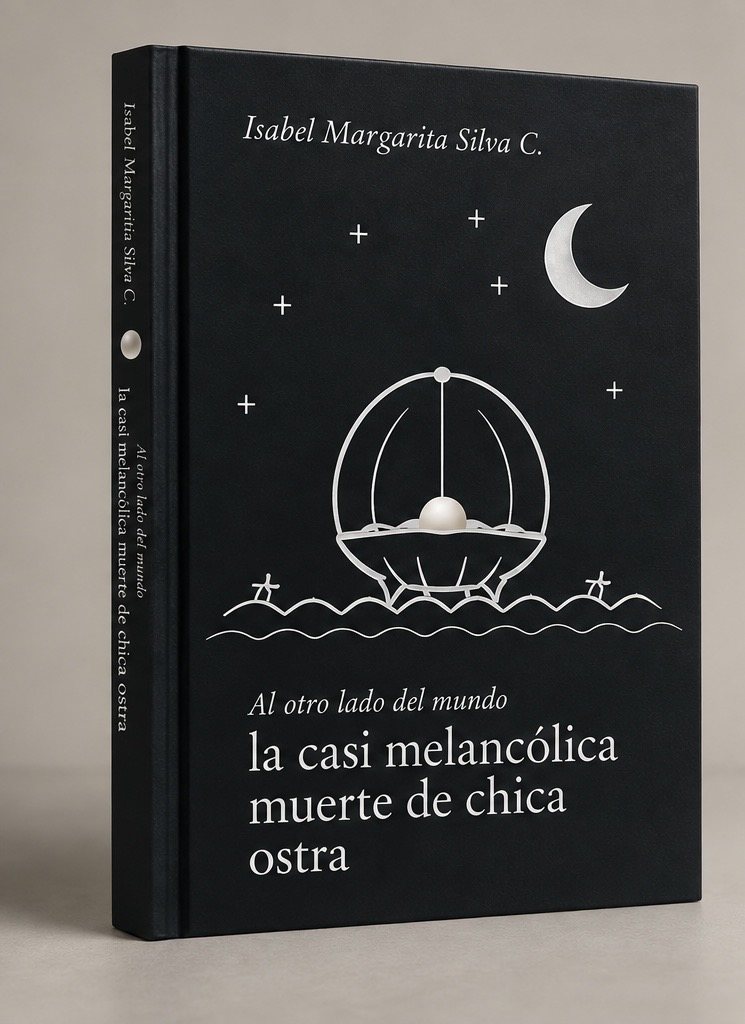
Cover of the book: an open oyster with a pearl beneath the moon, on a dark blue background

Spanish edition

  • A5 format, 128 interior pages
  • Ink illustrations, one for each poem
  • Echoes of the original marked in color
  • All seven poems in English at the back
  • ISBN 978-956-03-1154-2

Available now from Buscalibre, La Gata Escarlata and selected bookstores in Chile.

Run a bookstore? Get in touch →

For bookstores

Would you like to carry the book?

If you run a bookstore, a design shop or a cultural space and would like to sell Oyster Girl or host a reading, write to us and we will reply with terms and availability.

Frequently asked questions

What people usually ask

Is it a children's book?

No. It has illustrations and rhymes, but it is a book for adults. It deals with love and heartbreak, motherhood, loss and feeling different, with dark humor and a little tenderness.

Do I need to have read Tim Burton to understand it?

No. Oyster Girl stands on its own. Readers who know The Melancholy Death of Oyster Boy will recognize its echoes, marked in a different color, but you don't need it to follow the story.

How is it related to Tim Burton's book?

It is a poetic reply, not a sequel or an adaptation. Some lines deliberately coincide with Francisco Segovia's Spanish translation (Anagrama, 1999) and appear as echoes. It is an independent work by Isabel Margarita Silva C., with no connection to Tim Burton or his publishers.

Where can I buy it?

In Chile, from Buscalibre, La Gata Escarlata and selected bookstores. The retail price is CLP $22,000.

Is it available in English?

The Spanish edition includes all seven poems in English at the back of the book.

What is the book like?

A5 format, 128 interior pages, seven poems with an ink illustration for each. Published by Editorial Canal Comunicaciones, ISBN 978-956-03-1154-2.